4 min read
Gamification is not a game
Points, badges and leaderboards do not turn a lesson into a game. A few thoughts from Vocabiventures, ELT classrooms and museum tables.
Contents
I started designing board games during the same years I was studying English Language Teaching at Pamukkale University. Lesson plans on one side, rulebooks on the other. For a long time I treated them as two separate jobs. Then I noticed they were asking the same question: why would a person want to make a decision in the space you have put in front of them?
The word gamification tends to skip that question. Adding points, badges or a leaderboard to a lesson does not turn it into a game. It puts a counter on top of the homework. The counter works for a while. Then students start playing with the counter instead of the subject.
A game is a space for decisions
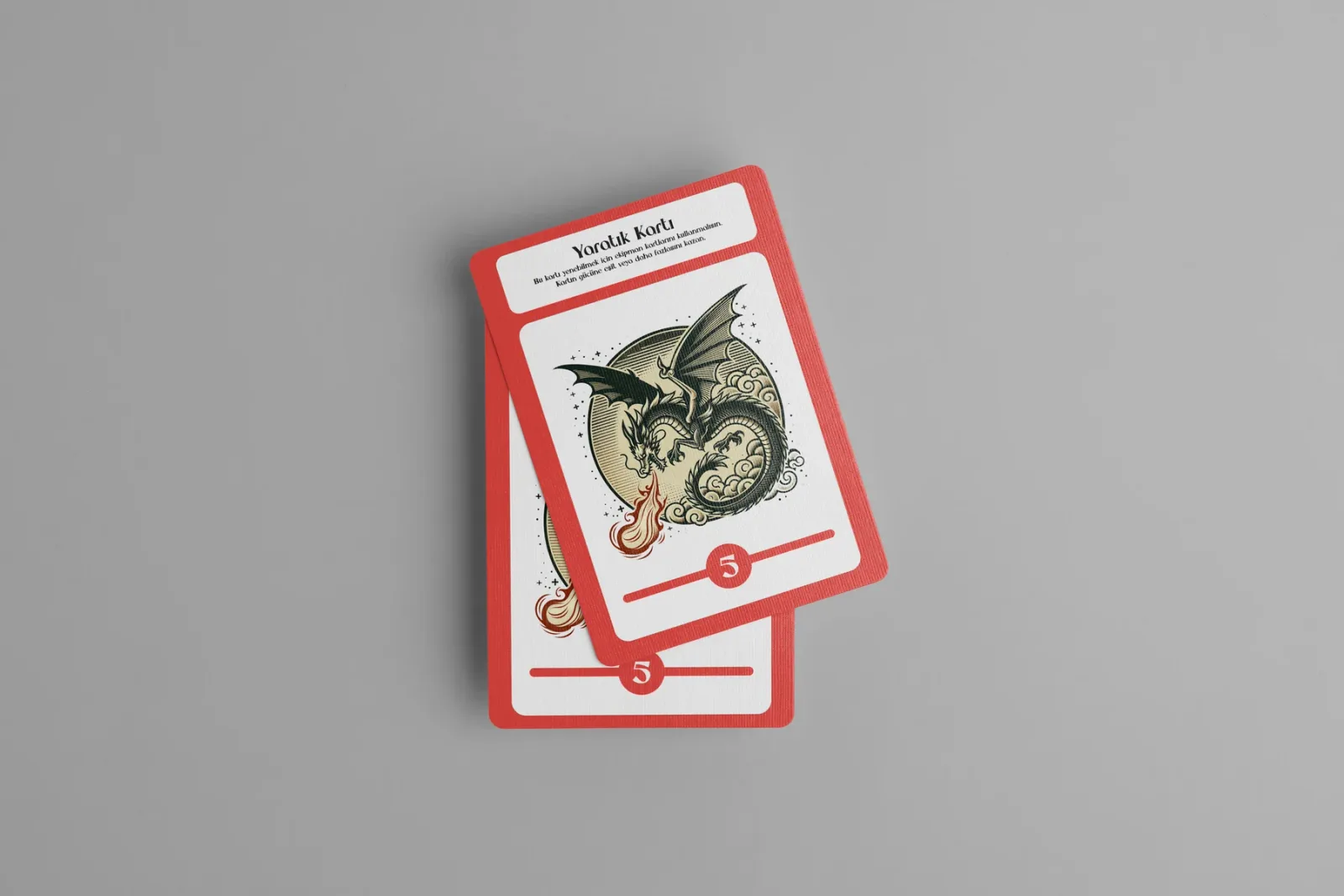
What interests me in a card game is not the card but the choices facing the person holding it. Which card do I play face down, what do I keep back, how do I read what the other player is about to do? A game is a space where those questions belong to the player. The rules draw the edges of that space; the player fills it.
A classroom is no different. Learning a word is not seeing it on a list. It is deciding to use it in a sentence. If students have no real choice in their hands, it does not matter how many points you stack on top; what they are doing is still memorising. A good learning game, to my mind, ties the word to a decision: knowing it changes something at the table. Not knowing it changes something too, and that should work more like a hint than a penalty.
Vocabiventures
The place where these thoughts turned into research was Vocabiventures, a gamified study on teaching vocabulary. I carried it out under TÜBİTAK’s 2209-A programme and presented it at INGED’s 22nd International ELT Conference in 2024.
I do not want to tell this as a success story. Vocabiventures is student research and a conference record, not an award. I would rather let the method and the talk stand than wrap them in big claims about impact. A room full of language teachers does not look at a game and ask whether it is fun. They ask what it teaches. I think that is the right question. At a fair stand a game has to carry its first five minutes; in a classroom, its fifth week.
Classroom, museum, stand
The years I spent teaching at YDS Akademi, American Culture and Yargı Akademi made me think of a teacher as a kind of game master. You explain the rules, keep the rhythm, and give a stuck player a nudge. A game does not get played without a rulebook, and a lesson does not work without a clear frame.
I tried the same idea outside the classroom. With Kaşif-i Şahane, designed for Topkapı Palace Museum, the goal was to move visitors from passive reading into discovery inside the building. With Bilgem Evreni, designed for TEKNOFEST, we wanted to present science as something you can play and explore, not a cold lesson. Leading projects on educational games at Usturlab taught me the same thing: however valuable the content, if it leaves the player no decision, it does not stay on the table.
There is one difference between a museum and a classroom, though. In a museum the player comes once; in a classroom they come back every week. A game played once can run on curiosity. A game played every week only survives if the decisions really change.
When it is a game, and when it is not
I am not against gamification. What I object to is taking the shell of a game and leaving it empty. Before I bring a game into a classroom, I ask myself one question: does the decision the student makes in this activity sit in the same place as the thing I want them to learn? If it does, the leaderboard is usually unnecessary. If it does not, no badge will save it.
There is a simple test I use: take the points away and picture the activity again. If people would still want to play it, it is probably a real game. If all that is left is a worksheet, the points were never the game.
A game can carry a lesson. But the lesson should not be the game’s decoration. It should be the game.