4 min read
Casus Belli: from a high-school deck to the shelf
Taking a deck to a shop shelf means deciding it is finished. Notes on the rules, the print run and the QR rulebook.
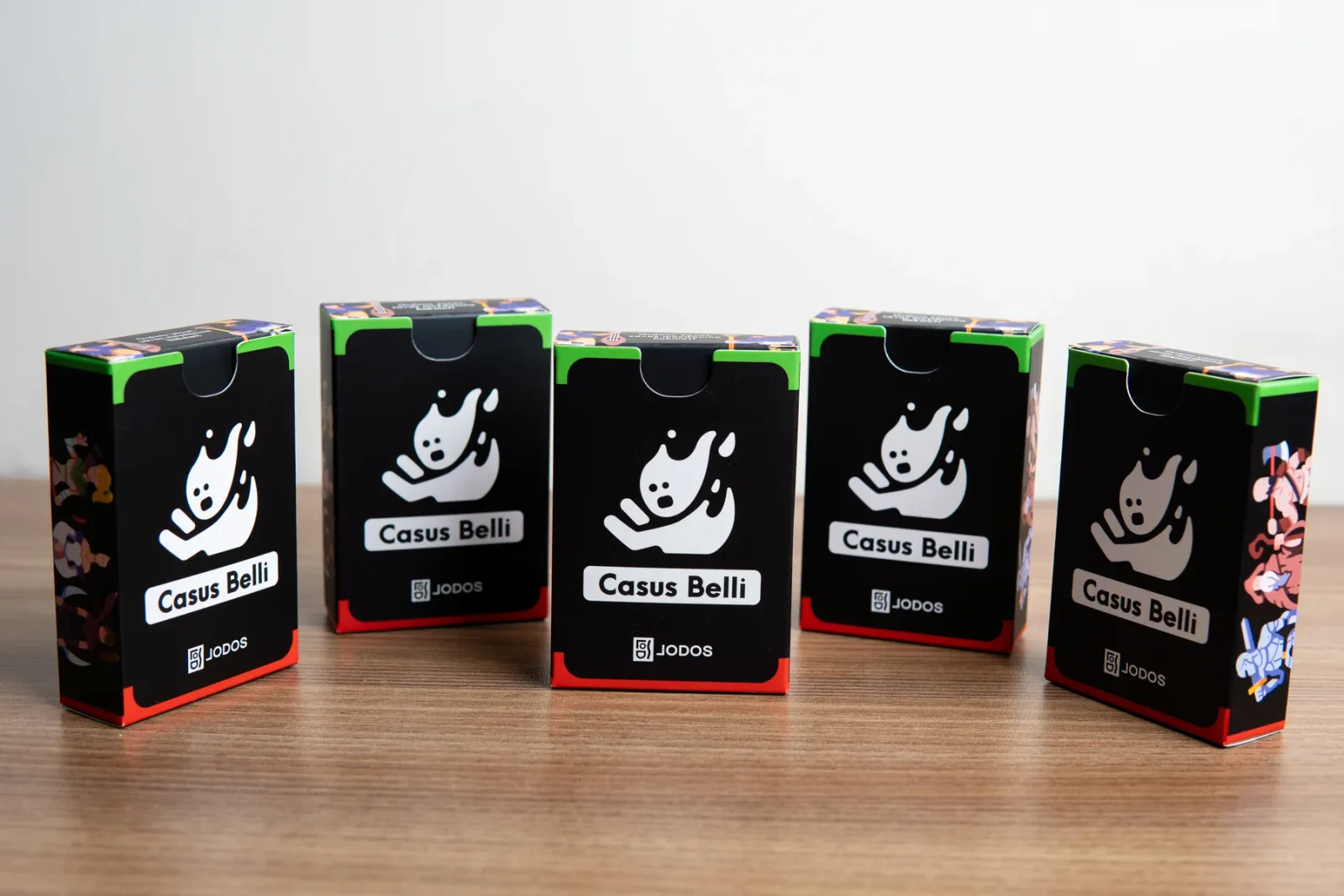
Casus Belli started in high school. The box, the credits panel and the print run came later. The box on my desk today is 74.8 millimetres wide, 105.5 tall and 31 deep. Four facts sit on the back: 2–4 players, ages 8 and up, 15 minutes, 50 cards. This is a note to myself about how I got to those four lines.
Where the rules locked
In its high-school form Casus Belli was less a game than an experiment. The rules locked in at university. Locking them meant one thing: the game had to work without me at the table. It had to explain itself.
The core is short. You start even and try to empty the other army. Cards land face down, flip, and resolve in order. Then the round resets. Luck, wits and bluff share one deck, and the people at the table decide which of them wins out. The King, the Queen, the Jester, the Northerner and the Peasant are the familiar faces in it.
Locking the rules was mostly about taking things away. Every rule raises a question, and every question is a pause at the table. A fifteen-minute game has no room for long pauses. Whenever I needed more than two sentences to explain a rule, the problem usually turned out to be the rule, not the sentences.
The thing you print once
When you publish your own game, the designer, the producer and the publisher are the same person. Casus Belli was designed, printed and is sold in Turkey, and each of those verbs asks for a different kind of patience. On screen you can change a card a hundred times. Once it leaves the printer, you cannot.
That finality made me think hardest about the rulebook. A rule printed on paper freezes on the day it is printed. The game keeps living, though: people try new modes, some sentences get misread, some cards get played in ways I did not expect. So I put a QR rulebook in the box. The print run happens once; the rulebook keeps updating. One printing, new modes.
Keeping the rulebook outside the box changed something else too: what goes on the back. A small card box has no room to explain rules, so the back has to be a summary: the pitch, the credits and a code that leads to the rulebook. Whoever opens the box learns the rest.
It looks like a small decision, but it carries a point of view. The box is a fixed object. The game is an ongoing conversation. I did not want to trap both on the same sheet of paper.
From the table to the shelf
Going on sale means the game no longer lives only at my table. Casus Belli has been played in university clubs including METU, ITU and Hacettepe. In 2023 it was on the table at the DIGIAGE winter camp. Its marketplace average is 4.4. I read that number as feedback rather than a trophy; the reviews next to it say more than the score does.
One buyer called it a game you throw in your bag, and that is one of my favourite lines about it. The size of a card box looks like a minor decision. That review told me it had landed in the right place: an object you carry around, that sets up and packs away in fifteen minutes.
KOSGEB R&D support and the Innovative Entrepreneur award are the official side of this story. They matter to me, but they do not say what the game is. What the game is shows up in the moment a face-down card turns over.
The classic edition came out in 2024 and the premium edition in 2025. Both are the same size of box; what changed is how it feels in the hand. Reprinting a game is not redesigning it. It is making the same decisions again, more carefully.
Today
When I look at Casus Belli I still see the high-school deck, only with cleaner edges. Maybe that is what getting a game onto a shelf means: lock the rules, accept that print is final, and hand the rest to the players. Each time the rulebook in the box updates, the game moves a little further away from me. I think that is how it should be.
You can look through the cards on the project page. The shop is at lodos.org.